Welcome to Chem Zipper.com......: Name reactions

Search This Blog

Showing posts with label Name reactions. Show all posts

Saturday, October 10, 2026

Stephen reaction

Nitriles are reduced to corresponding imine with stannous chloride in the presence of hydrochloric acid, which 
on hydrolysis give corresponding aldehyde. This reaction is called Stephen reaction.

Rosenmund Reduction


The Rosenmund reduction is a hydrogenation process in which an acyl chloride is selectively reduced to an aldehyde. The reaction was named after Karl Wilhelm Rosenmund who first reported it in 1918. The reaction is catalysed by palladium on barium sulfate, which is sometimes called the Rosenmund catalyst. 
Barium sulfate has a low surface area which reduces the activity of the palladium, preventing over-reduction. However for certain reactive acyl chlorides the activity must be reduced further, by the addition of a poison. Originally this was thioquinanthrene although thiourea[2] has also been used. Deactivation is required because the 
system must reduce the acyl chloride but not the subsequent aldehyde. If further reduction does take place it will create a primary alcohol which would then react with the remaining acyl chloride to form an ester.

Schotten Baumann Reaction


The Process of benzoylation of compounds containing active hydrogen such as phenol, Aniline, Alcohol etc. with benzoyl chloride in the presence of aqueous NaOH is called Schotten Baumann reaction.

Rosenmund Reduction


The Rosenmund reduction is a hydrogenation process in which an acyl chloride is selectively reduced to an aldehyde. The reaction was named after Karl Wilhelm Rosenmund who first reported it in 1918. The reaction is catalysed by palladium on barium sulfate, which is sometimes called the Rosenmund catalyst. 
Barium sulfate has a low surface area which reduces the activity of the palladium, preventing over-reduction. However for certain reactive acyl chlorides the activity must be reduced further, by the addition of a poison. Originally this was thioquinanthrene although thiourea[2] has also been used. Deactivation is required because the 
system must reduce the acyl chloride but not the subsequent aldehyde. If further reduction does take place it will create a primary alcohol which would then react with the remaining acyl chloride to form an ester.

Kolbe Schmitt Reaction

Sodium Phenoxide reacts with carbon dioxide under pressure (4-7) atmosphere at 400 K to form sodium salicylate which on acidification with mineral acid gives salicylic acid. This reaction is called Kolbe reaction

The Kolbe–Schmitt reaction or Kolbe process (named after Hermann Kolbe and Rudolf Schmitt) is a carboxylation chemical reaction that proceeds by heating sodium phenolate (the sodium salt of phenol) with carbon dioxide under pressure (100 atm, 125 °C), then treating the product with sulfuric acid. The final product is an aromatic hydroxy acid which is also known as salicylic acid(the precursor to aspirin)

Mechanism 

The Kolbe–Schmitt reaction proceeds via the nucleophile addition of a phenoxide, classically sodium phenoxide (NaOC6H5), to carbon dioxide to give the salicylate. The final step is reaction of the salicylate with acid to form the desired salicylic acid.

Reimer Tiemann Reaction


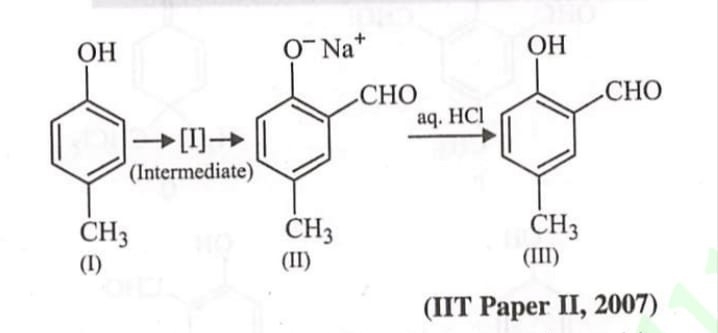
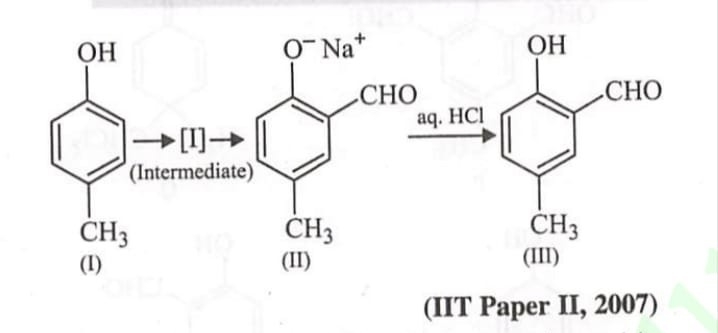
Treatment of Phenol with Chlorform in the presence of aqueous sodium or potassium  hydroxide at 340K followed by hydrolysis of the resulting product gives 2 hydroxy benzaldehyde (salicylaldhyde) . This reaction is called Reimer Tiemann reaction.

if CCl4  is taken in the place of chloroform then Salicylic acid is form .

Saturday, July 5, 2025

Williamson's Synthesis.

⇒It is the laboratory method for the preparation of ethers. 

⇒It is a nucleophilic substitution reaction and proceeds through the SN2 mechanism.
⇒ Order of reactivity of primary halide is CH3X > CH3CH2X > CH3CH2CH2X. 
⇒ Tendency of alkyl halide to undergo elimination is 3º > 2º > 1°. 

⇒ For better yield alkyl halide should be primary and alkoxide should be secondary or tertiary.