Welcome to Chem Zipper.com......

Search This Blog

Wednesday, December 18, 2024

Intensive properties:

After specifying the parameter of the system, when system is divided in parts the parameter whose value remains unchanged due to division is known as Intensive parameter or properties. the value of intensive  is independent of the  mass (size or quantity) of the system.

  1. Refractive index
  2. Surface tension
  3. Viscosity
  4. Molar Mass
  5. Density
  6. Free energy per mole
  7. Specific heat capacity
  8. Molar heat capacity
  9. Free energy per mole
  10. Pressure (P)
  11. Temperature (T)
  12. Boiling point
  13. freezing point etc
  14. Molar enthalpy
  15. Molar conductivity
  16. Equivalent conductivity
  17. Molarity, Normality, Mole fraction, %w/w, %V/V
  18. EMF of cell

Tuesday, December 10, 2024

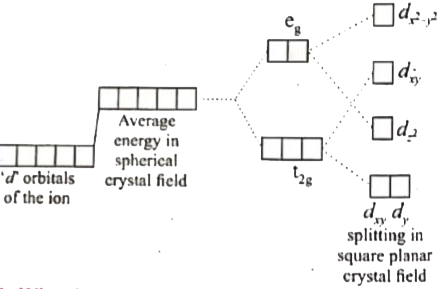
Splitting of d-Orbital in squar planar complexes.

As the lobes of dx^2y^2 point towards the ligands , this orbital has highest energy . The lobes of dxy orbital lie between the ligands but are coplanar with them orbital is next highest energy . The lobes of dz^2 orbital point out of the plane of the complex but the belt around the centre of the orbital (which contain 1/3 of the electron density ) lies in the plane. Therefore dz^2 orbital is the next highest in energy. The lobes of dzx and dzy orbitals point out of the plane of the complex . Hence , they are least affected by the electrostatic field of the ligands. They are degenerate and lowest in energy .

What is synergic bonding , Bonding in metal Carbonyl , Bond order of M-C and C-O in synergic Bond


(1) Stretching frequency of CO is inversely proportional to negative oxidation state of central metal atom

(2) Extent of back bonding or back acceptance is directly proportional to negative oxidation state of central metal atom.

(3) M-C bond order is directly proportional to negative oxidation state of central metal atom

(4) C-O bond order is inversely proportional to negative oxidation state of central metal atom.

(5) d C-O bond length is directly proportional to negative oxidation state of central metal atom.

(6) Bond energy of C-O bond is inversely proportional to negative oxidation state of central metal atom 


What is the heating effect on the nitrates of the alkali metals like Li, Na, K, Cs and Rb etc.

Nitrates are prepared by the action of nitric acid on a metal or its oxide, hydroxide or carbonate. All nitrates are soluble in water. On heating, the nitrates of the alkali metals yield only oxygen and the nitrite (Except Lithium).

Most of the nitrate salts of other metals on heating decompose to produce metal oxide ,nitrogen dioxide (NO2) and oxygen gas. (Except M= Na, K, Rb, Cs but lithium(Li) do as above)


Sunday, December 8, 2024

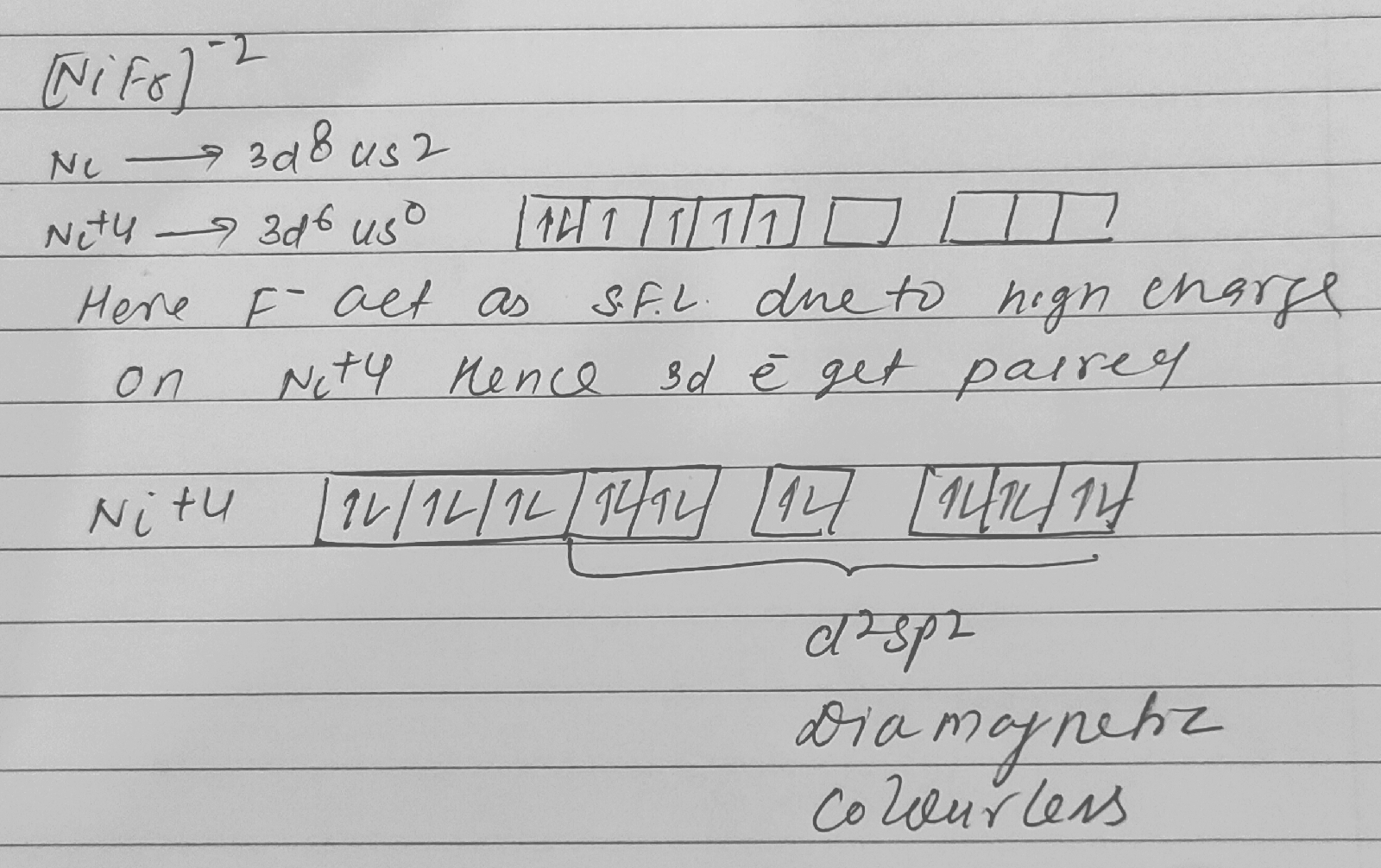
What is Hybrization and magnatic behaviour of [NiF6]-2 complex ?

[NiF6]-2 :  This is the exceptional case:
Here F^-1 work as strong field ligand due to presence of high charge hence Zeff is also high  in this complex [NiF6]-2