Carbon tetrachloride (SiCl4) easily hydrolysed due to availability of vacant d – orbitals in valence shell of their central atom ( Silicon), hence it can easily extend their coordination number beyond four but this is not possible in case of carbon tetrachloride (CCl4) due to absence of vacant d – orbitals in carbon atom.

Sunday, February 2, 2020

What is Laporte Selection rule?
Laporte Selection Rule
is given by Otto Laporte a German American Physicist
Related Question:
According to Laporte
selection rule only allowed transitions are those occurring with a change in
parity (flip in the sign of one spatial coordinate.) OR During an electronic transition the azimuthal quantum number can
change only by ± 1 (Δ l = ±1) The Laporte selection
rule reflects the fact that for light to interact with a molecule and be
absorbed, there should be a change in dipole moment.
Practical meaning of the
Laporte rule:
Laporte allowed
transitions: are those which occur
between gerade to ungerade or ungerade to gerade orbitals.
Laporte forbidden transitions: are
those which occur between gerade to gerade or ungerade to ungerade orbitals.
Gerade = symmetric with respect to centre of inversion i.e.
atomic or molecular orbital with center of symmetry or number of nodal plane =
0, 2, 4 (even number)
Ungerade = anti symmetric with respect to centre of inversion
i.e. atomic or molecular orbital without center of symmetry or number of nodal
plane = 1, 3, 5, (odd numbers)
Important Note:
This rule affects
Octahedral and Square
planar
complexes as they have center of symmetry. Tetrahedral complexes do not have center of symmetry therefore this rule does not apply
Related Question:
Which of the
Complex of the following pairs has the highest value of CFSE?
Colour of
Complexes due to charge transfer:
Why violet
colour of [Ti(H2O)6]Cl3 disapear (colourless) on heating heating ?
Why [Ni(CN)4]-2
is colourless while [Ni(H2O)4]-2 although both have +2 oxidation state and 3d*8
configuration ?
Why [FeF6]3– is
colourless whereas [CoF6]3– is coloured ?
Why Fe(CO)5 is
colourless while Fe(bipy)(CO)3 is intensely purple in colour ?
Why all the
tetrahedral Complexes are high spin Complexes ?
Colour of Complexes due to charge transfer:
Why violet colour of [Ti(H2O)6]Cl3 disapear (colourless) on heating heating ?
Why [Ni(CN)4]-2 is colourless while [Ni(H2O)4]-2 although both have +2 oxidation state and 3d*8 configuration ?
Why [FeF6]3– is colourless whereas [CoF6]3– is coloured ?
Why Fe(CO)5 is colourless while Fe(bipy)(CO)3 is intensely purple in colour ?
Why all the tetrahedral Complexes are high spin Complexes ?
Although both [Mn(H2O)6]2+ and [FeF6]3- have a d5 configuration and high-spin complexes. But the dilute solutions of Mn2+ and Fe +3 complexes are therefore colorless. Why?
Both [Mn(H2O)6]2+
and [FeF6]3- have a d5 configuration
and high-spin complexes, but electronic transitions are not only
Laporte-forbidden, but also spin-forbidden. thus the dilute solutions of Mn2+
and Fe +3 complexes are colorless.

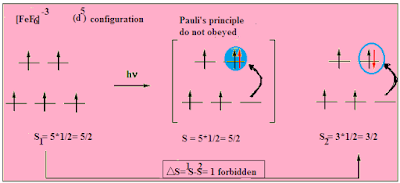
Important Note:


For
first transition series d5 system,
weak ligand field , and coordination number six (6) Complexes are found to be
colourless due to violation of selection rule.
What is the Selection rule for colour in complexes?
Spin
selection rule states that transitions that involve a change in spin
multiplicity as compare to ground state are forbidden.

(2) If Δ S ≠ 0 (change in spin multiplicity after transition) then it is forbidden
(transition not allowed)

Related Question:
(1) According to this rule,
any transition for which Δ S = 0 (it means no change in
spin multiplicity after d-d transition) is allowed.


Intensity of colour due to d-d
transition:
(1) Intensity of colour due
to d-d transition will found to be high if transition follow laporte selection
rule.
(2) Intensity of colour due
to d-d transition will found to be poor due violation of laporte selection
rule.
(3) Intensity of colour in
tetrahedral Complexes for (non centre of symmetry) is found to be higher than
octahedral (centre of symmetry).
Important Note:
For
first transition series d5 system, weak
ligand field, and coordination number six (6) Complexes are found to be
colourless due to violation of selection rule.
Related Question:
Which of the
Complex of the following pairs has the highest value of CFSE?
Colour of
Complexes due to charge transfer:
Why violet
colour of [Ti(H2O)6]Cl3 disapear (colourless) on heating heating ?
Why [Ni(CN)4]-2
is colourless while [Ni(H2O)4]-2 although both have +2 oxidation state and 3d*8
configuration ?
Why [FeF6]3– is
colourless whereas [CoF6]3– is coloured ?
Why Fe(CO)5 is
colourless while Fe(bipy)(CO)3 is intensely purple in colour ?
Why all the
tetrahedral Complexes are high spin Complexes ?
Colour of Complexes due to charge transfer:
Why violet colour of [Ti(H2O)6]Cl3 disapear (colourless) on heating heating ?
Why [Ni(CN)4]-2 is colourless while [Ni(H2O)4]-2 although both have +2 oxidation state and 3d*8 configuration ?
Why [FeF6]3– is colourless whereas [CoF6]3– is coloured ?
Why Fe(CO)5 is colourless while Fe(bipy)(CO)3 is intensely purple in colour ?
Why all the tetrahedral Complexes are high spin Complexes ?
Which of the Complex of the following pairs has the largest value of CFSE? (1) [Co(CN)6]3- and [Co(NH3)6]3+ (2) [Co(NH3)6]3+ and [CoF6]3- (3) [Co(H2O)6]3+ and [Rh(H2O)6]3+ (4) [Co(H2O)6]2+ and [Co(H2O)6]3+
(1) CN is the stronger
ligand than NH3 therefore CFSE of [Co(CN)6]3- will be more
than [Co(NH3)6]3+
Related Question:
(2) NH3 is stronger ligand than F therefore CFSE of [Co(NH3)6]3+ will be more than [CoF6]3-.
(3) Co belongs to 3d series whereas The Rh belong to 4d series. More the value of n more is CFSE therefore CFSE of [Rh(H2O)6]3+ is more than [Co(H2O)6]3+ .
(4) Oxidation number of Co in [Co(H2O)6]3+ is more than the Oxidation number of [Co(H2O)6]2+ therefore, CFSE of [Co(H2O)6]3+ is more than [Co(H2O)6]2+.
(3) Co belongs to 3d series whereas The Rh belong to 4d series. More the value of n more is CFSE therefore CFSE of [Rh(H2O)6]3+ is more than [Co(H2O)6]3+ .
(4) Oxidation number of Co in [Co(H2O)6]3+ is more than the Oxidation number of [Co(H2O)6]2+ therefore, CFSE of [Co(H2O)6]3+ is more than [Co(H2O)6]2+.
Related Question:
Which of the
Complex of the following pairs has the highest value of CFSE?
Colour of Complexes due to charge transfer:
Why violet colour of [Ti(H2O)6]Cl3 disapear (colourless) on heating heating ?
Why [Ni(CN)4]-2 is colourless while [Ni(H2O)4]-2 although both have +2 oxidation state and 3d*8 configuration ?
Why [FeF6]3– is colourless whereas [CoF6]3– is coloured ?
Why Fe(CO)5 is colourless while Fe(bipy)(CO)3 is intensely purple in colour ?
Why all the tetrahedral Complexes are high spin Complexes ?
Colour of Complexes due to charge transfer:
Why violet colour of [Ti(H2O)6]Cl3 disapear (colourless) on heating heating ?
Why [Ni(CN)4]-2 is colourless while [Ni(H2O)4]-2 although both have +2 oxidation state and 3d*8 configuration ?
Why [FeF6]3– is colourless whereas [CoF6]3– is coloured ?
Why Fe(CO)5 is colourless while Fe(bipy)(CO)3 is intensely purple in colour ?
Why all the tetrahedral Complexes are high spin Complexes ?
Subscribe to:
Posts (Atom)