Welcome to Chem Zipper.com......

Search This Blog

Sunday, May 31, 2020

Why Guanidine behave as the strongest base among neutral compounds?. explaine the remarkable basicity of guanidine.

Basicity of Guanidine:
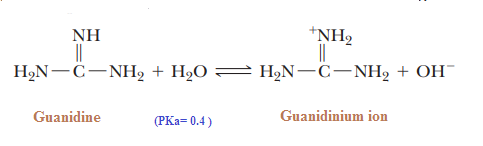
Guanidine is the strongest base among neutral compounds:


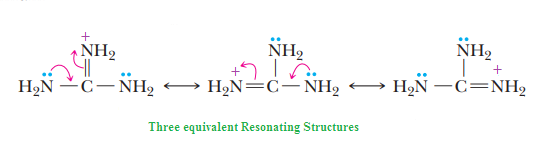
The remarkable basicity of guanidine is attributed to the fact that the positive charge on the guanidinium ion is delocalized equally over the three nitrogen atoms, as shown by
these three equivalent resonating  structures:

Basicity of nitrogen can be increased by attachment topi-donors (NH2) group. These two pi-donating NH2groups donate electron density to the (pi-accepting) C=NH. Hence, the guanidinium ion is a highly stable cation.

What is Guanidine and its structure , name amino acid which contains guanidine group ?

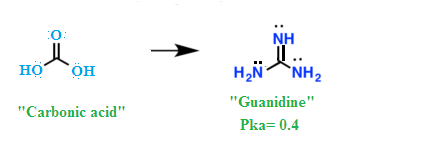
Guanidine is strongest organic nitrogenous compound with the formula HNC(NH2)2. Guanidine is analogue of carbonic acid. That is, the C=O group in carbonic acid is replaced by a C=NH group, and each OH is replaced by a NH2 group.

A guanidine group also appears in larger organic molecules, including on the side chain of arginine (a basic amino acid).


It is a colourless solid that dissolves in polar solvents. It is a strong base that is used in the production of plastics and explosives. It is found in urine as a normal product of protein metabolism.

What is correct acidic strengths order of the haloforms acids ? Give correct explanation.

We know that acidic strength of the acid also depends upon stability of conjugate bases, so for relative strength of acid, we need to check the relative stabilities of their conjugate bases.

                                                     CF3-, CCl3-, CBr3- CI3-

We are expecting the acidic strength haloform acids asCHF3, CHCl3, CHBr3, CHI3 in decreasing order. Because Fluorine is most electronegative atom so it would be stabilize CF3- more, as electronegativity decreases from F to I the stability of conjugate -ve ion would be but that is not correct the actual order isCHCl3 > CHF3 > CHBr3 > CHI3.

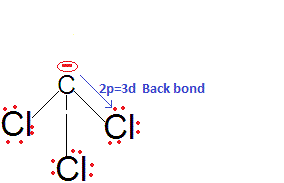
This is because there is effective back bonding in CCl3-and hence the negative charge partially gets stabilised by back donation to the vacant 3d orbitals of Cl. Thus, CHCl3 is a stronger acid than CHF3 and also among them due to 2pπ-3dπ back bonding.


The acidic strengths of the other three haloforms can be compared the inductive effects of their anions. F is very electronegative and hence stabilises the negative charge on the C atom. So, CHF3 is a better acid than CHBr3, and the least acidic is CHI3.

 The overall acidic strength order is:
     CHCl3 > CHF3 > CHBr3 > CHI3.

Saturday, May 30, 2020

Why are bridge head carbocations unstable?

According to Bredt’s rule a bridgehead carbon atom of bicyclo compound cannot be sp2 hybridised or in other word a bridgehead carbon atom cannot be form double bond. unless the ring that contains at least eight atoms.

Related Questions:

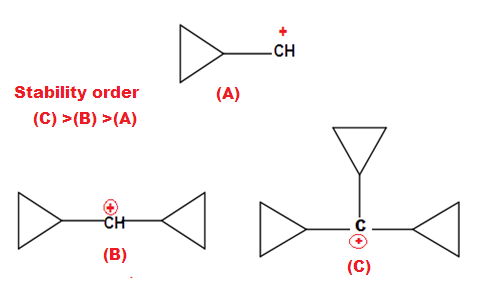
Why is cyclopropyl methyl carbocation exceptionally stable?

The exceptional stability of cyclopropane methyl cation can be explained by the concept of dancing resonance concept. The stability of additional cyclopropyl group , is result of more conjugation between the bent orbital of cyclopropyl ring and cationic carbon.
The most stable carbocation known till date in organic chemistry is explain by Dancing resonance.
Related Questions: