Welcome to Chem Zipper.com......

Search This Blog

Wednesday, April 29, 2020

0.0833 moles of a carbohydrate having empirical formula of CH2O contains one gram hydrogen, find molecular formula

Given EF= CH2O then mass=30
And carbohydrate(CH2O) contains 1gram hydrogen:
From EF it is obvious that 2 grams hydrogen present in 30 grams then 1grams hydrogen present in 15 grams corbohydrate.

Number of moles = Given mass/M.Mass
                              0.0833  =15/M.mass
Then M.mass=180

We Must needed 
Molecular Formula(MF) = n× Empirical Formula (EF)
MF=6(CH2O) = C6H12O6
Where n = Molecular mass/Empirical mass
             n= 180/30=6

Monday, April 27, 2020

Which carbocation is more stable : Benzyl or Tertiary?

Some time it is dilemma tertiary is more stable than Benzylic or benzylic is more stable than tertiary carbocation.
But their is two case (1) Primary benzylic carbonation is less stable than 3° carbocation because the tertiary carbocation is stablized due to +I effect and +H effect, while benzylic carbocation stabilised by +R effect only thus tertiary become more stable than primary Benzylic . 
In (2) case of secondary and tertiary benzylic carbocation become more stable than tertiary because now +H effect also operates along with +R effect.

Similar Questions:

Saturday, April 25, 2020

What is the Raoult's law and it's application ?

RAOULT'S LAW:
(1) Vapour pressure of a number of binary solutions of volatile liquids such as benzene and toluene at constant temperature gave the following generalization which is known as the Raoult's law.
(2) Raoult's law states that "The partial pressure of any volatile component of a solution at any temperature is equal to the vapour pressure of the pure component multiplied by the mole fraction of that component in the solution
(A) Vapour pressure of liquid-liquid Solution:
(3) Suppose a binary solution contains nA moles of a volatile liquid A and nB moles of a volatile liquid B, if PAand PB are partial pressure of the two liquid components, the according to Raoult's law
(4) If the vapour behaves like an ideal gas, thenaccording to Dalton's law of partial pressures, the total pressure P is given by 
Graphical representation of Raoult's law:
(5) The relationship between vapour pressure and mole fraction of an ideal solution at constant temperature is shown. The dashed lines 1 and 2 represent the partial pressure of the components. The total vapour pressure is given by 3rd line in the above figure.

(B) Vapour pressure of Solid-liquid Solution:
(1) Vapor pressure, when a small amount of a non-volatile solute (solid) is added to the liquid (solvent). It is found that the vapour pressure of the solution is less than that of the pure solvent.
(2) The lowering of vapour pressure is due to the fact that the solute particles occupy a certain surface area and evaporation takes place from the surface only. and
(3) The particles of the solvent will have a less tendency to change into vapour i.e. the vapour pressure of the solution will be less than that of the pure solvent and it is termed as lowering of vapour pressure.
For a solution of non-volatile solute with volatile solvent.

What is Vapour pressure of liquid ?

VAPOUR PRESSURE:
(1) If a sample of water in its liquid phase is placed in an empty container, some of it will vaporize to form gaseous of water. This change is called evaporation.
(2) The pressure exerted by the vapour (molecules in the vapour phase) over the surface of the liquid at the equilibrium at given temperature is called the vapour pressure of the liquid.
OR
(3) It is the pressure exerted by the vapour when vapours are equilibrium with the liquid.
(4) The pressure exerted by vapours is called unsaturated vapour pressure or partial vapour at non equilibrium condition
Factors affecting vapour pressure:
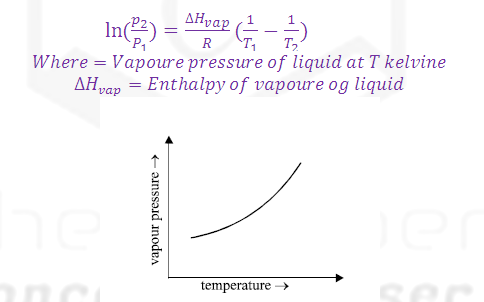
(A) Temperature:.
(1) The temperature at which the vapour pressure of the liquid becomes equal to the atmospheric pressure is called its boiling point.
(2) Vapour pressure is directly proportional to theTemperature so that on increasing temperature the rate of evaporation increases and rate of condensation decreases and hence vapour pressure increases.
(3) The dependence of vapour pressure and temperature is given by CLASIUS CLAPERON equation.

(4) Vapour pressure of a particular liquid system is only the function of temperature only. It is independent from all other factors like surface area, amount of liquid, available space etc.

(A) Nature of liquid:
Vapour pressure of liquid =1/the strength of intermolecular forces acting between molecules 
For example: CCl4 has higher vapour pressure because of the weak intermolecular forces acting between its molecules than water which has stronger intermolecular forces acting between water molecules of volatile liquid has lower boiling point than a non-volatile liquid.
 Note:
(1) Relative lowering of vapour pressure of a solvent is a colligative property equal to the vapour pressure of the pure solvent minus the vapour pressure of the solution.
(2) For example: water at 20°C has a vapour pressure of 17.54 mmHg. Ethylene glycol is a liquid whose vapour pressure at 20°C is relatively low, an aqueous solution containing 0.010 mole fraction of ethylene glycol has a vapour pressure of 17.36 mmHg. Thus the vapour pressure lowering, DP = 17.54 mmHg ¾ 17.36 mmHg = 0.18 mmHg.

Explain factors affecting solubility of a substance .

Factors affecting Solubility:
Earlier we have observed that solubility of one substance into another depends on the nature of the substances. In addition to these variables, two other parameters, i.e., temperature and pressure also control this phenomenon.
(1) Effect of temperature:
The solubility of a solid in a liquid is significantly affected by temperature changes. Consider the equilibrium exist between dissolution and crystallisation. This, being dynamic equilibrium, must follow Le Chateliers Principle. In general…….
(i) If in a nearly saturated solution, the dissolution process is endothermic (Δsol H > 0), the solubility should increase with rise in temperature and
(ii) If it is exothermic (Δsol H > 0) the solubility should decrease. These trends are also observed experimentally.
(2) Effect of Pressure:
Pressure does not have any significant effect on solubility of solids in liquids. It is so because solids and liquids are highly incompressible and practically remain unaffected by changes in pressure.
(2) Solubility of gas in Liquid: 
Many gases dissolve in water. Oxygen dissolves only to a small extent in water. It is this dissolved oxygen which sustains all aquatic life. On the other hand, hydrogen chloride gas (HCl) is highly soluble in water. Solubility of gases in liquids is greatly affected by pressure and
temperature.
Factors affecting Solubility:
(1) Effect of Pressure:
The solubility of gases increase with increase of pressure. For solution of gases in a solvent, consider a solution is act as system and that system to be in astate of dynamic equilibrium, i.e., under these conditions rate of gaseous particles entering and leaving the solution phase is the same. Now increase the pressure over the solution phase by compressing the gas to a smaller volume, this will increase the number of gaseous particles per unit volume over the solution and also the rate at which the gaseous particles are striking the surface of solution to enter it. The solubility of the gas will increase until a new equilibrium is reached resulting in an increase in the pressure of a gas above the solution and thus its solubility increases.